Apps
Announcements




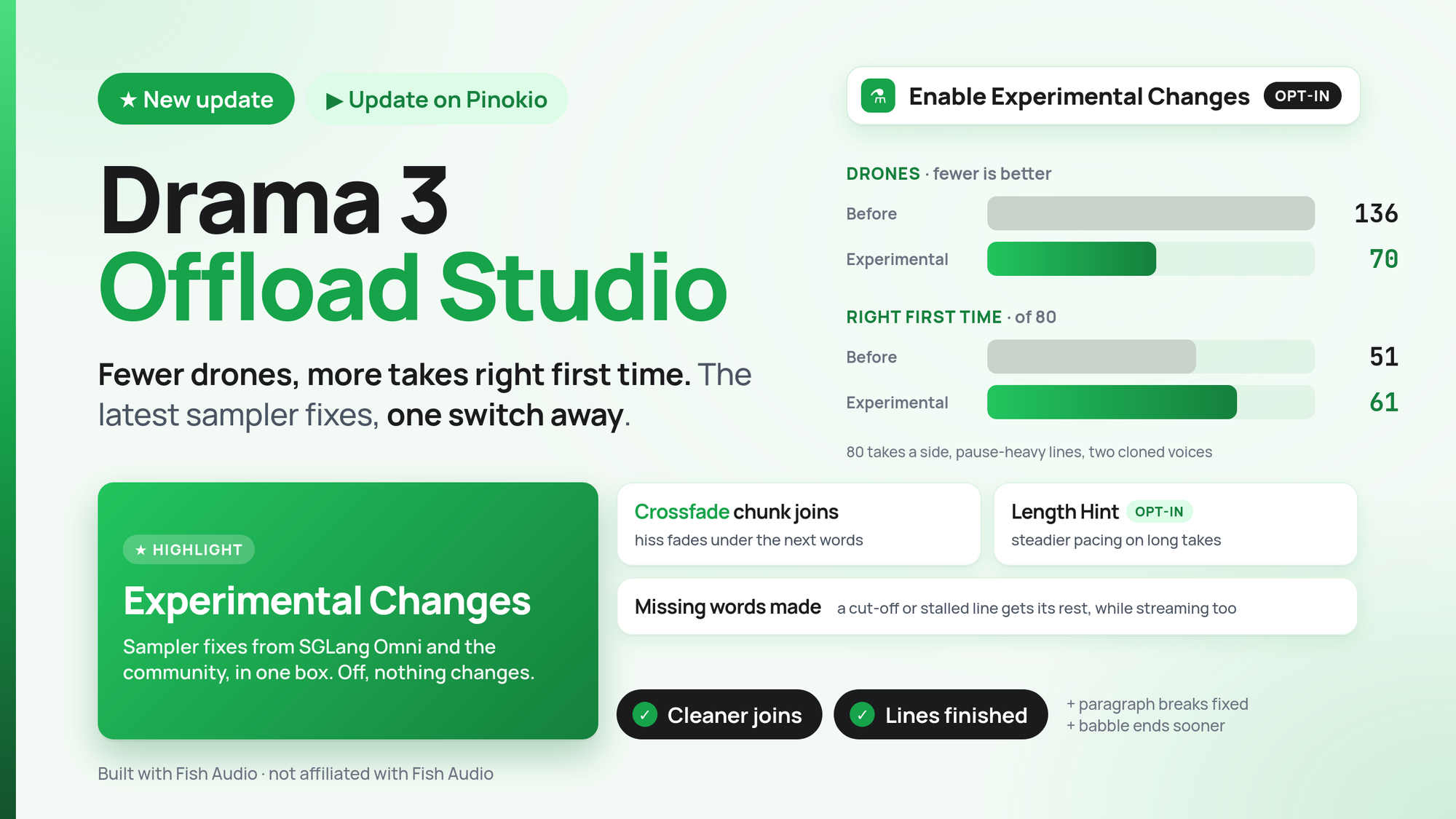
Major Update: Experimental Changes from the Community + Length HintMany bug fixes and smaller issues fixed! Also I added two new opt-in options: Experimental Changes and Length Hint! Please check out if you want, might really improve your generation! ⚗️ Enable Experimental Changes (opt-in) One new checkbox switches on sampler fixes that others have found since Drama 3's release: - Uncut main token: the main token is drawn with no top-p cut, so a drone can end. Top-p 0.9 was cutting off the end-of-speech token on every step (torenyx/drama3-24gb). - Looser stall retry: a take that stalls is remade with a looser repeat-avoiding draw (same source). - SGLang Omni's fixes of 2026-10-20: the acoustic codebooks are capped at 30 candidates, and the redraw keeps the token that crosses top-p. - Register guard: in Quality Mode, a take where one phrase jumps far above the voice's pitch is made once more (from drama-tensorfold). The first two changes (the uncut main token and the looser stall retry) were tested together on pause-heavy lines, with 80 takes a side and two cloned voices: - Drones: 70 instead of 136. - Right first time: 61 takes instead of 51. 🔀 Crossfade chunk joins (on by default) Long scripts no longer play a burst of hiss between chunks. Each chunk keeps full level just past its last word, then only its trailing breath and hiss fade out under the next chunk's first words. No word is ever faded in or out. In blind tests it beat the old trimmed end with a silent pause at 5 of 6 joins. 📏 Length Hint (opt-in) Tells Drama 3 roughly how long each line should take, using its own [audio tokens: N] hint. That gives steadier pacing, and in blind tests it was preferred on long takes. ✍️ Missing words made When a take or a long script's chunk stops early or stalls, its missing words are made as a continuation of it. That now works while streaming too, and in Quality Mode it's tried before remaking the whole take. Bug fixes - Paragraph breaks fixed: blank lines in a script no longer make the model go silent instead of ending. - Babble ends sooner: runaway takes are cut at 2.5× their expected length instead of 3×. - Cleaner chunk ends: with crossfading off, chunk ends keep their last consonant (an 80 ms hold before the fade). Thanks to SGLang Omni, Frosty40, torenyx, plotarmordev, gabacool and mlx-speech, whose findings these are built on.
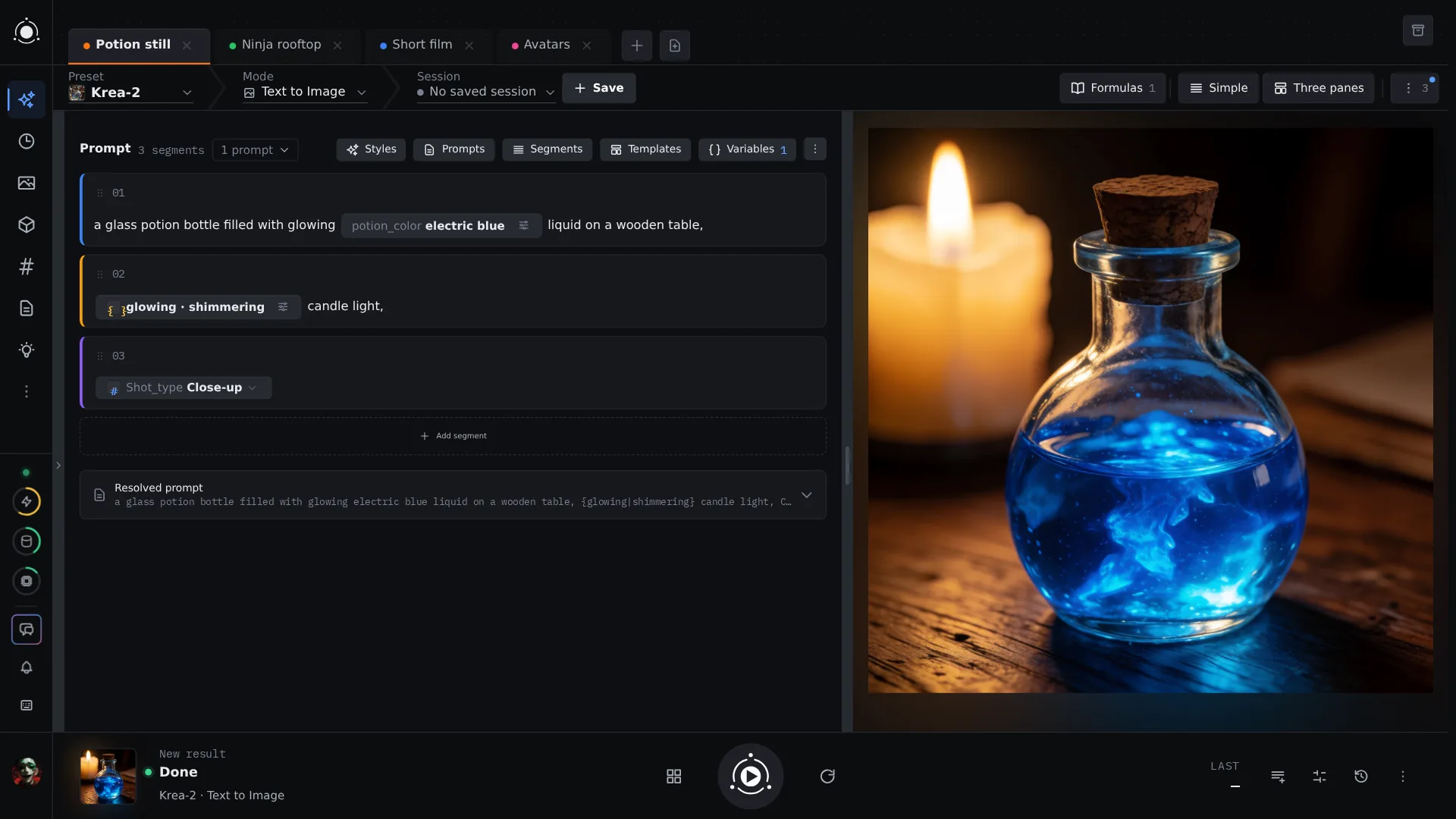
PotionUI 0.0.17 — instant model indexing, MOSS-Image, prompt conditions and a new Generate pagePotionUI is a self-hosted studio for AI images, video and audio. You pick a preset, write your prompt in colored segments with variables and phrasebook chips, and generate on your own NVIDIA GPU, or on a cloud model when you want one. Everything you make lands in a searchable History with the exact settings and model files behind it. What's new in 0.0.17 Models are ready at once. Point PotionUI at your existing model folder (a ComfyUI or A1111 one works) and every model is listed in seconds. Setup no longer reads your whole library first. Checking each file happens quietly in the background, at a gentle pace, and pauses while you generate. After setup you choose once: index everything in the background, pick the models you use, or decide later. Prompts that change per image. Add if / else conditions to a prompt: when a variable rolls "electric blue", the scene gets cold blue light; when it rolls "emerald green", green steam curls from the cork. The preview shows exactly which branch every image takes before you spend any GPU time. Also new History links you can bookmark or share open a generation's full details directly. Model Tools for admins: shrink a model to FP8, INT8 or NVFP4, and bake or merge LoRAs, right from the app. New native models: MOSS-Image, FLUX 3 Klein in its official INT8 format, and an experimental Text Enhancer for Krea-2 that follows long prompts more closely. PotionAI, the built-in assistant, can show its thinking while it answers, if your admin turns it on. Sign in straight through your own identity provider (OIDC), with a recovery login kept aside. A cleaner Generate page: preset, mode and session in one toolbar, and a now-playing deck for your running and finished generations. Pictures and videos now show inside Pinokio's window. What PotionUI can do Direct a short film. Chain shots so each one starts from the last frame of the one before, on a local video model or a cloud one. Mix your references. Drop pictures, a video clip and an audio track into one prompt and cite each with @. Keep everything findable. Collections, search, filters and tags across all your images and videos, and every result keeps its prompt, seed and models. Models with ready-made presets include SDXL, Flux, FLUX 3 Klein, Qwen-Image, Krea-2, Z-Image, MOSS-Image, Anima, Wan, LTX and MiniMax video, YuE and MiniMax music, SeedVR2 upscaling, and TRELLIS 3D. ComfyUI workflows and cloud providers plug in too. Install or update New here: click Install on the PotionUI page in Pinokio, then Start. You need Windows or Linux with an NVIDIA GPU (driver 580 or newer, 8 GB VRAM and 16 GB RAM at least). Other machines get a remote-only install that works with a remote worker or a cloud backend. Already installed: click Update, then Start. Before you update, back up data/storage in the PotionUI app folder (your database and outputs). The update upgrades the database, so going back to 0.0.16 needs that backup. GitHub: https://github.com/PotionUI/PotionUI — a star helps more people find it. Community: r/PotionUI and Discord.



FooocusPlusFeatured
An enhanced version of Fooocus giving you access to all of the latest AI image generation models
 @morpheus
 5 check-ins
Drama 3 Offload StudioFeatured
Fish Audio Drama 3 (expressive TTS, voice cloning, voice design, directing notes) from the fishaudio/Drama-3 Space. Models: the full model for 24+ GB NVIDIA GPUs, the Small GGUF (drama3-small, Japanese and English) for 16 GB, and MLX 4-bit / 3-bit conversions of the full model for Apple Silicon (64 / 48 GB, untested on a Mac).
 @thomas_eric
 5 check-ins
YUE2 // GROOVEFeatured
YUE2 // GROOVE is the latest music studio built on the open-source Yue2 model and its inference stack. Generate high-quality full songs from style and lyrics with an editable score plan — powered by the latest YuE model — cover from audio with SheetSage2 and MERT2, refine and compare edits, and keep your works in a reusable, easy-to-manage library. You get high-quality creation with real creative control. Hardware: an NVIDIA GPU with 24 GB VRAM on Linux (YuE2's recommended setup, validated end-to-end on NVIDIA L4 hosts; a 16 GB memory budget runs everything the app can produce, and 12 GB runs the unquantized model at CFG 1.0 or for shorter songs) or an Apple Silicon Mac with 32 GB+ unified memory (where this app is developed and tested). Windows is best effort: install, launch, Cover and a full-length song verified on Windows 11 (RTX 2070, 8 GB); song generation there runs through the GGUF engine. Cards under 16 GB (and Windows) get the optional GGUF engine: the same model through yue2.cpp with an 8-bit backbone, 8.2 GB peak for a full song, measured indistinguishable from the reference rendering in a blind ABX, a different take for the same seed; the reference PyTorch configuration stays the default wherever it fits.
 @bearbone
 11 check-ins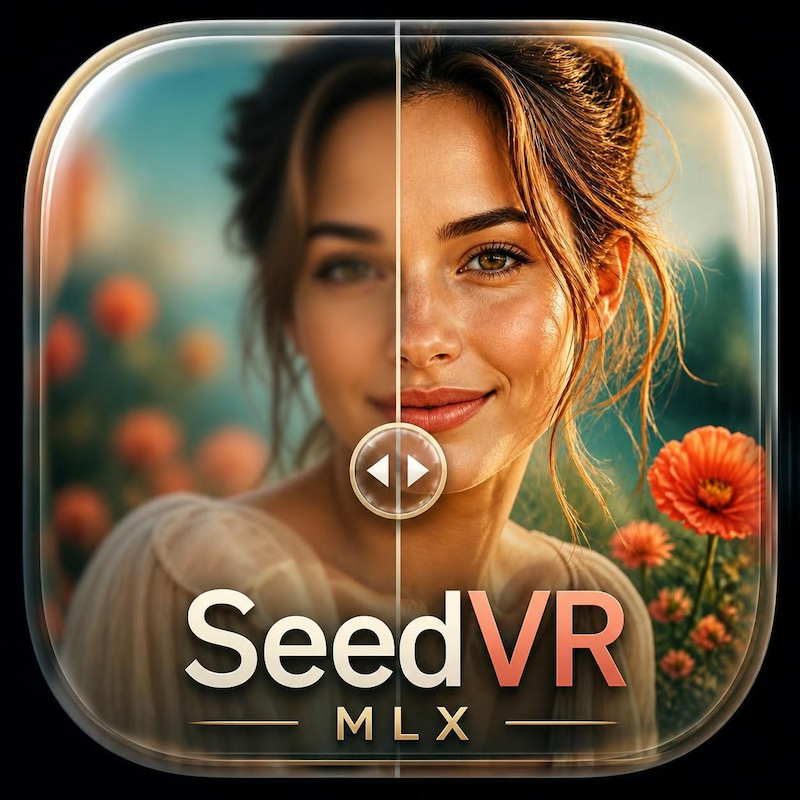
SeedVR2-7B MLXFeatured
One-step SeedVR2-7B diffusion super-resolution upscaler, running natively on Apple Silicon via MLX. Choose between fp16 / int8 / sharp model variants, tune scale, softness, and seed, and compare before/after with a slider.
 @rdx_ai3 check-ins
PulseForgeFeatured
A fully local, cross-platform audio visualizer editor. Create reactive music videos with layered graphics, AI-transcribed lyrics, and frame-perfect MP4 exports — all running in your browser
 @theawakenone4 check-ins
theDAWFeatured
Full-featured DAW, DJ, and VJ app interoperable w/Ableton, Reaper, Resolume & more. Stable Audio 3, Magenta RT2, Lyria 3 Pro, Suno API, Chimera track fusion, Demucs stems, MIDI generate/notate, rule-based composer (harmony, counterpoint, fugue), orchestra sound bank w/concert-hall reverb, VST3 instruments, MPE, native Audima Labs Sway support, img > spectrogram > music, drawing > music, VST3 & .gan plugins, automix & key-lock, GLSL shaders, volumetric video, Quest 3 XR interface, MIDI auto-map, RAG assistant, asset library with example projects
 @gantasmo
 8 check-ins



MiniJamFeatured
Describe any song in plain English, compose a structured caption and lyrics locally, and generate it with MiniMax Music 3.
@cocktailpeanut1 check-in
MiniMax H3 ComfyUIFeatured
MiniMax H3 omni-modal video generation in ComfyUI. Text/image/video/audio in, video with native 32kHz stereo audio out (768p default, 1080p+ supported). Disk-optimized: pruned INT8 + NVFP4 weights (~63GB instead of ~290GB). NVIDIA only.
@thomas_eric

 56 check-ins
SongGeneration StudioFeatured
AI Song Generation with Full Style Control - Generate complete songs with lyrics, vocals, and instrumental tracks using Tencent AI Lab's SongGeneration (LeVo) model. [NVIDIA ONLY]
@morpheus
 21 check-ins


AgentsViewFeatured
Browse, search, and analyze sessions from Claude Code, Codex, and other coding agents locally.
@cocktailpeanut5 check-ins
GeoLibreFeatured
A free, open-source GIS for visualizing, exploring, and analyzing geospatial data locally in your browser.
@cocktailpeanut4 check-ins
Uncensored Local StudioFeatured
Run image generation, GGUF language models, Whisper speech recognition, and Kokoro speech synthesis locally from one offline studio.
@cocktailpeanut
 34 check-ins
MuScriptorFeatured
Local multi-instrument audio-to-MIDI transcription from Kyutai and Mirelo.
@cocktailpeanut

 27 check-ins




StableDAWFeatured
Browser-based AI audio DAW for Stable Audio 3 with text-to-audio, inpainting, LoRA training, FFmpeg effects, waveform editing, sequencer, piano roll, and persistent library. https://github.com/gantasmo/stabledaw
@cocktailpeanut

 26 check-ins
Image to PromptFeatured
Generate editable Ideogram JSON prompts from uploaded images.
@cocktailpeanut
 10 check-ins
IdeopromptFeatured
Describe an image, get a 100% schema-valid Ideogram 4 JSON prompt — generated fully locally with an embedded llama.cpp (no Ollama or LM Studio required).