WanGP has added support for Hy-Nomas, a world model from Tencent:
https://hy-nomas.hy.tencent.com/
You can generate the world using:
- WASD control
- Natural language prompt
Here's an example where I pressed "D" (move right), and then entered "The fox climbs up the tree":
Getting it to work
It's kind of hidden, you have to click the earth icon to open the world model view, which will display the Hy-Nomas option.
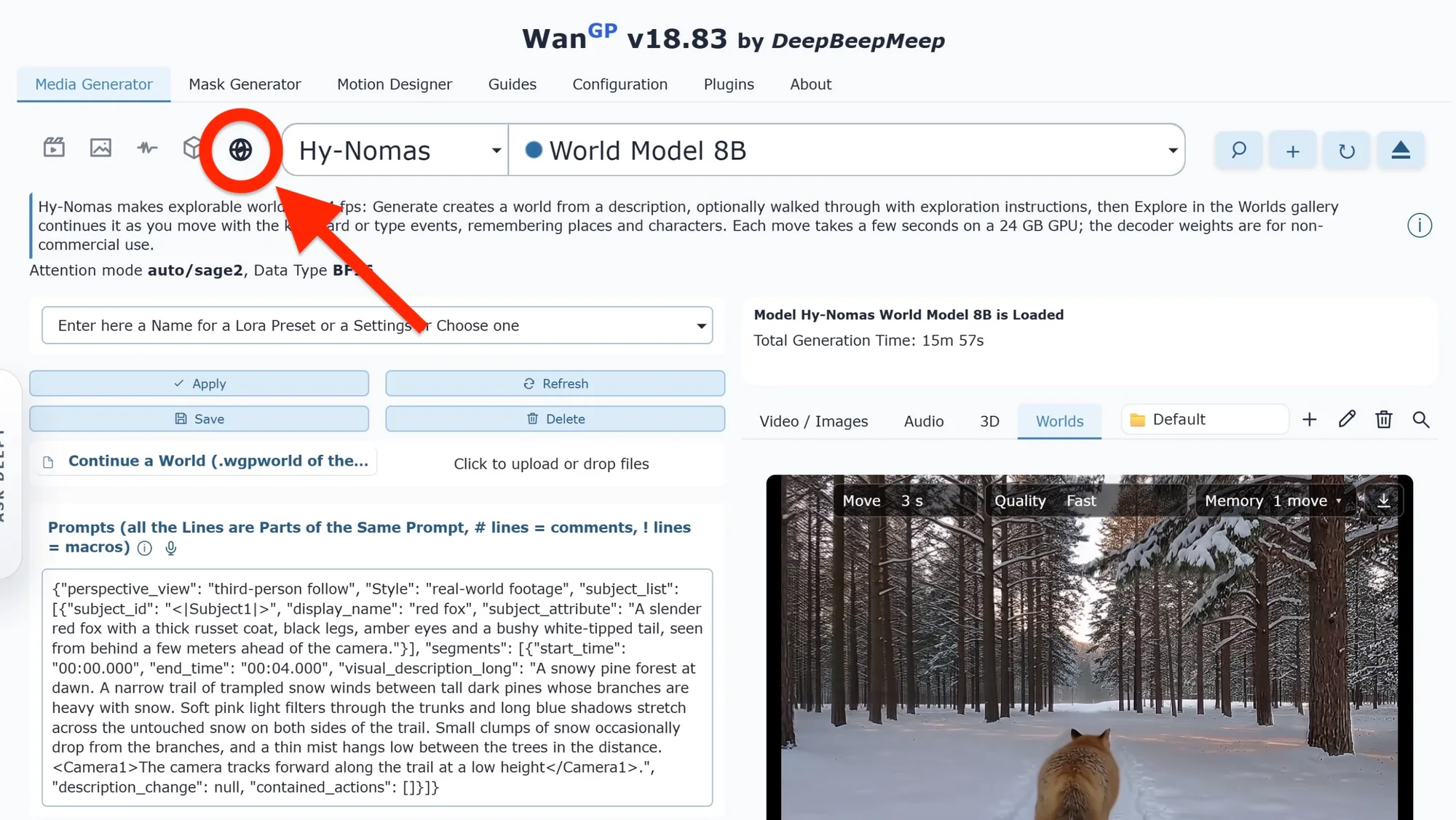
The default prompt is already filled out so you can start out by simply clicking "generate" to generate the initial world.
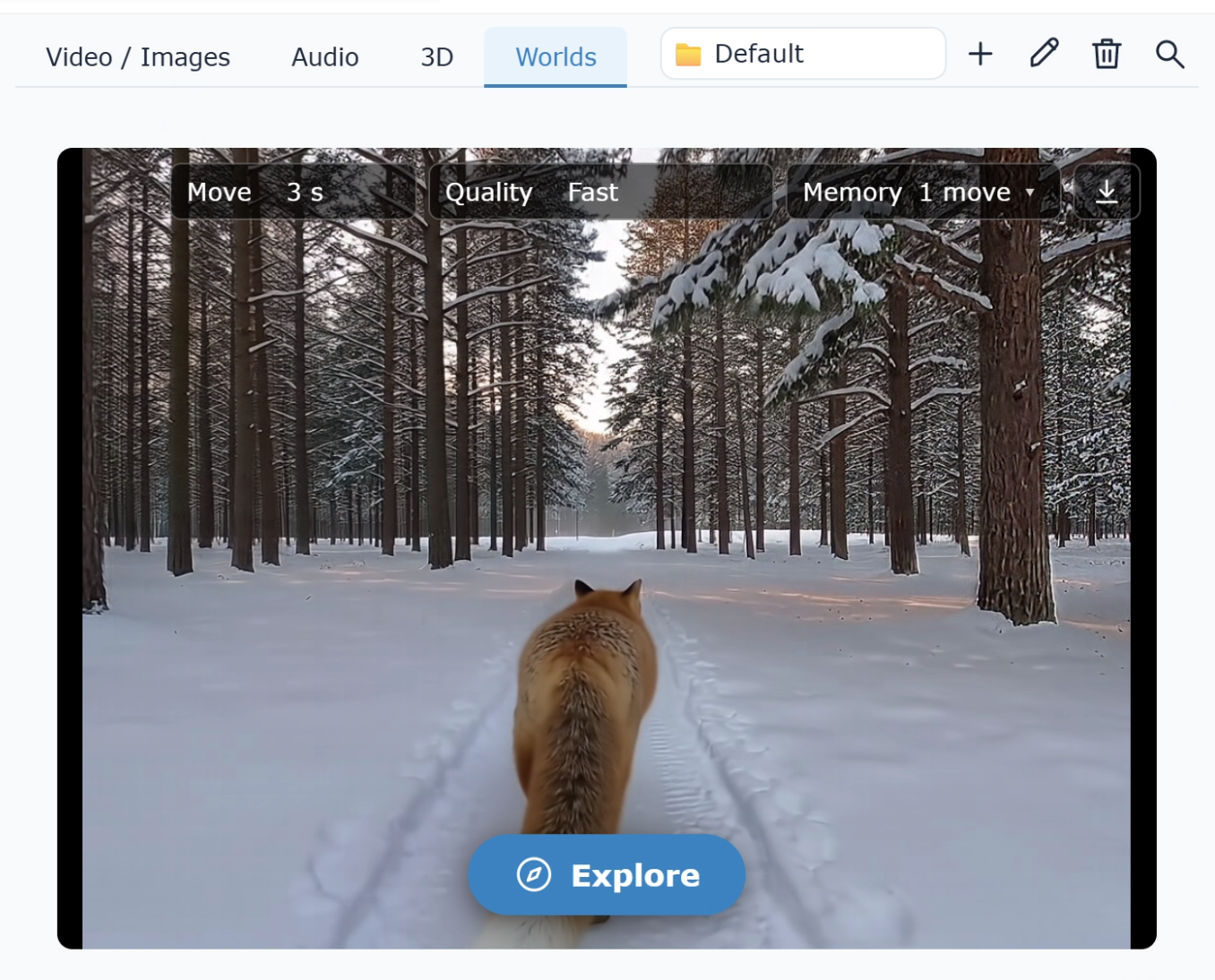
Once generated, you should be able to click "Explore" to explore the world, which loads the generated world (this takes some time to initialize)
Should work REALTIME on 24GB+ VRAM
Of course, the most important part: Does this work on my PC? I think if you have at least 24GB VRAM it should work in realtime.
Should work on low VRAM (8GB+ VRAM) but not realtime
But if you don't have 24GB VRAM? The model still runs with as low as 8GB VRAM, but the generation itself is probably not going to be realtime.
Does it matter if not realtime?
So why bother? If it's not realtime, isn't it just a glorified video generation model with shorter generation time? Not quite.
1. It’s a closed loop, not a single prompt. A video model takes one prompt and returns a finished clip, and you can’t step in halfway through. A world model generates a chunk, takes your next input (camera move, "fox climbs the tree"), then generates the next chunk from everything so far. That's what the page means by "Multi-turn Prompt Control" and "Interleaved Text + Camera Control". Running slowly turns it into a turn-based game instead of a real-time one, but it’s still interactive, and you can branch: same world, different action, different outcome.
2. The world persists. The "Consistent World Memory" claim is important. If you pan away from a building and come back, it should still be the same building. Normal video models drift or forget after a few seconds, which is why they top out at roughly 5–10s clips. Keeping a world consistent for up to 60 seconds of free camera movement implies the model has learned something like 3D structure and object permanence, not just plausible-looking pixels.
Why it matters even when it is slow
- Long, controllable video: If you just want a minute-long shot where the camera moves through a coherent space, a world model is the better video tool, even offline.
- Training and evaluating agents and robots" Simulators don't need to run in real time. They need to respond to actions and stay consistent, which is exactly what this adds.
- Previz and game prototyping: You can walk through a scene before anyone builds it in 3D.
- Speed tends to improve: Realtime is mostly an inference-optimization problem (distillation, fewer steps, quantization). Stable Diffusion went from minutes per image to real-time on consumer GPUs in under two years, and the capability arrived before the speed did. Not to mention there are already models like Overworld that demonstrates realtime is already possible:
https://pinokio.co/apps/github-com-cocktailpeanut-overworld-pinokio
Basically, it's not fair to call these "video model with faster generation". It's more like a video model trained to respond to your actions and remember the world it has generated.
Speed decides whether it feels like a game, but the action conditioning and memory are what make it useful. Just need to go faster.
Anyway, definitely worth trying out!



WanGP has added support for Hy-Nomas, a world model from Tencent:
https://hy-nomas.hy.tencent.com/
You can generate the world using:
Here's an example where I pressed "D" (move right), and then entered "The fox climbs up the tree":
Getting it to work
It's kind of hidden, you have to click the earth icon to open the world model view, which will display the Hy-Nomas option.
The default prompt is already filled out so you can start out by simply clicking "generate" to generate the initial world.
Once generated, you should be able to click "Explore" to explore the world, which loads the generated world (this takes some time to initialize)
Should work REALTIME on 24GB+ VRAM
Of course, the most important part: Does this work on my PC? I think if you have at least 24GB VRAM it should work in realtime.
Should work on low VRAM (8GB+ VRAM) but not realtime
But if you don't have 24GB VRAM? The model still runs with as low as 8GB VRAM, but the generation itself is probably not going to be realtime.
Does it matter if not realtime?
So why bother? If it's not realtime, isn't it just a glorified video generation model with shorter generation time? Not quite.
1. It’s a closed loop, not a single prompt. A video model takes one prompt and returns a finished clip, and you can’t step in halfway through. A world model generates a chunk, takes your next input (camera move, "fox climbs the tree"), then generates the next chunk from everything so far. That's what the page means by "Multi-turn Prompt Control" and "Interleaved Text + Camera Control". Running slowly turns it into a turn-based game instead of a real-time one, but it’s still interactive, and you can branch: same world, different action, different outcome.
2. The world persists. The "Consistent World Memory" claim is important. If you pan away from a building and come back, it should still be the same building. Normal video models drift or forget after a few seconds, which is why they top out at roughly 5–10s clips. Keeping a world consistent for up to 60 seconds of free camera movement implies the model has learned something like 3D structure and object permanence, not just plausible-looking pixels.
Why it matters even when it is slow
https://pinokio.co/apps/github-com-cocktailpeanut-overworld-pinokio
Basically, it's not fair to call these "video model with faster generation". It's more like a video model trained to respond to your actions and remember the world it has generated.
Speed decides whether it feels like a game, but the action conditioning and memory are what make it useful. Just need to go faster.
Anyway, definitely worth trying out!