Quick recap for anyone new: Castwright turns a book into a full-cast audiobook — every character in its own voice, kept consistent across a series — rendered locally on your own machine. Source-available (FSL), solo project, in beta. Here's what's new in v1.15.0.
Voice cloning is in. Record or upload a short sample, confirm it's your voice — or a family member's, with their say-so (their name is recorded, and the clone is refused without it) — and cast it as any character, in any book. It renders on both Qwen3-TTS and Coqui XTTS v2, and reads a non-English book in that book's language, though a clone sounds most like its owner in the language it was recorded in; the wizard says so before you record. Nothing leaves the machine: the sample, its transcript and everything built from it stay local, and Revoke erases the lot. If a clone can't be rebuilt as itself (sample missing, voice revoked, book on the wrong engine), the render stops and says why rather than quietly handing the character to a stand-in.
Analysis with any model. Point the analyzer at any OpenAI-compatible server — llama.cpp, llama-swap, LM Studio, vLLM, or OpenRouter — alongside local Ollama and Gemini. Each model gets a Test button that checks it really follows the output format before you spend a book on it (thinking models included), a reasoning-level control, and a block for your own request params. Tell it which GPU the server lives on and it asks before sharing the card your voices are using. More: https://www.castwright.ai/features#any-model
Character identity survives a re-analysis. Re-analysing now only adds to the cast: names, voices and merges stay put, and an uncertain new name gets asked about rather than guessed. "Link to this character" tells Castwright two names are one person. Chapters already hit by the old ID drift need one re-render.
GPU memory looks after itself. Voice designs and Quality previews make the room they need on an 8 GB card, and a speech engine that hits a memory ceiling or a transient GPU error restarts on its own.
Also: My voices now holds designed and cloned voices side by side (design once, cast anywhere; "Don't reuse" gives a character its own); more quote styles across all seven languages (Swiss «…» still partial); and dash-dialogue speaker matching in Russian, French and Spanish is far steadier — on one full Russian novel, affected chapters went from as low as 2% matched to over 92%.
Pinokio: this Update is a big one, once. The first Update to v1.15 does a one-time full voice-engine reinstall and takes noticeably longer; on NVIDIA it pulls about 1.3 GB more (the cuDNN and cuBLAS wheels). A plain restart doesn't trigger it. Pinokio moves to its own Node 24 with this release, but that lands one Update late — if Castwright says its Node is too old, press Update again. If you run Coqui, press Repair on it once (Admin → Model Manager → Installed models). And reload any Castwright tab left open from before the update. Walkthrough: https://www.castwright.ai/blog/updating-to-v1-15-on-pinokio
Where it's still honest: solo project, beta. The clone wizard's record/consent step currently renders with plain browser controls — it works, it just looks rough, and a fix is ticketed. I'd still love testers on an AMD card (supported via ROCm, but I've no AMD hardware to verify it), and anyone cloning a voice in a language other than English.
Hear a sample: https://www.castwright.ai/#demo · Full release notes: https://github.com/dudarenok-maker/Castwright/wiki/Release-Notes-v1.15.0 · castwright.ai · Feedback or a hand: [email protected].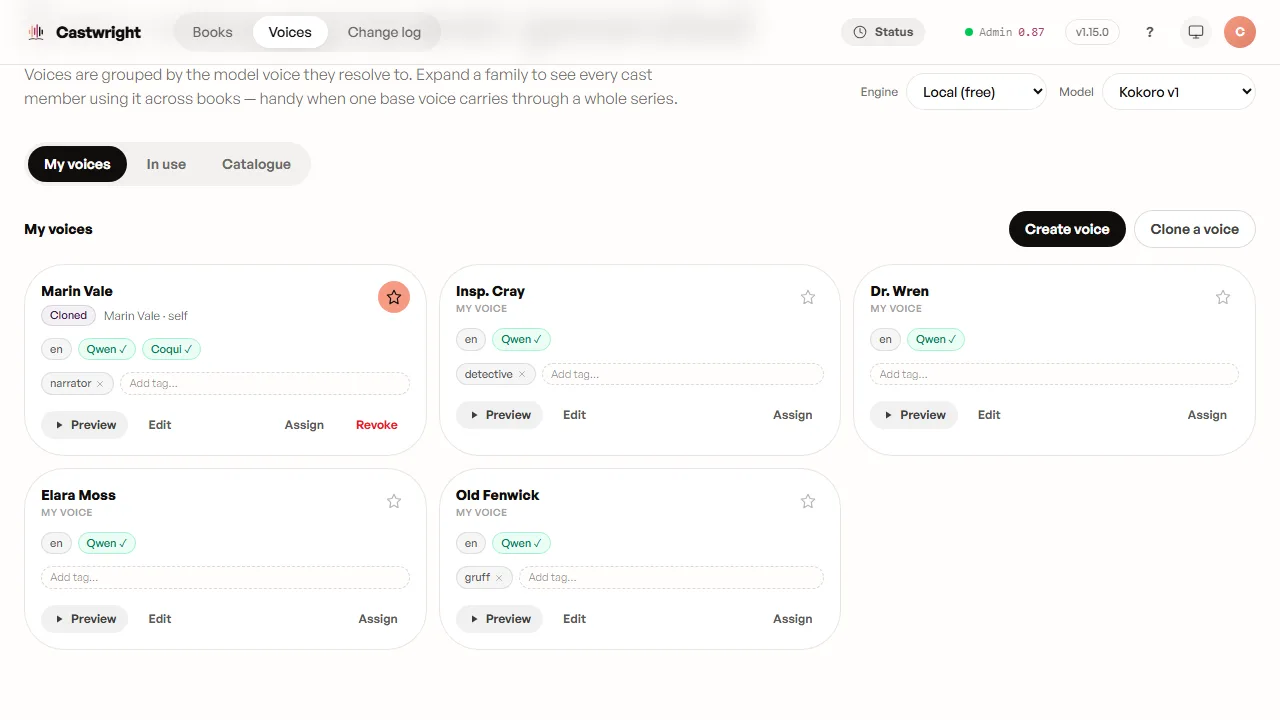

Quick recap for anyone new: Castwright turns a book into a full-cast audiobook — every character in its own voice, kept consistent across a series — rendered locally on your own machine. Source-available (FSL), solo project, in beta. Here's what's new in v1.15.0.
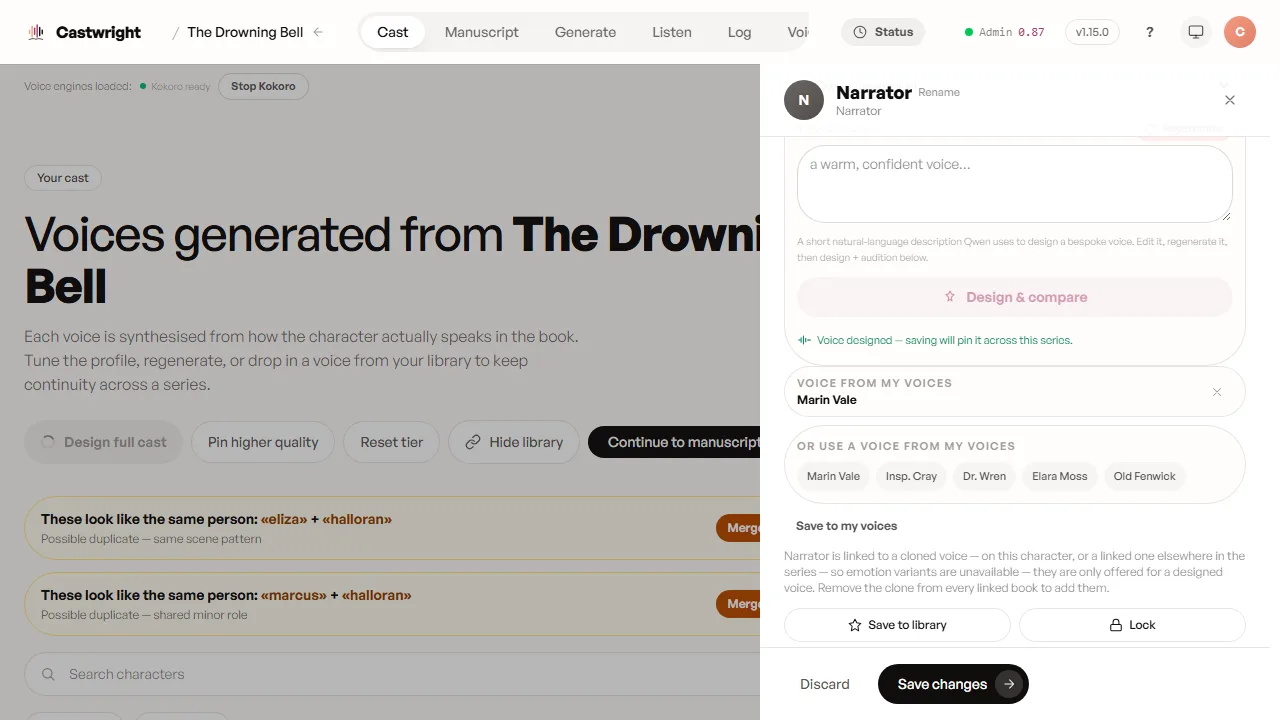
Voice cloning is in. Record or upload a short sample, confirm it's your voice — or a family member's, with their say-so (their name is recorded, and the clone is refused without it) — and cast it as any character, in any book. It renders on both Qwen3-TTS and Coqui XTTS v2, and reads a non-English book in that book's language, though a clone sounds most like its owner in the language it was recorded in; the wizard says so before you record. Nothing leaves the machine: the sample, its transcript and everything built from it stay local, and Revoke erases the lot. If a clone can't be rebuilt as itself (sample missing, voice revoked, book on the wrong engine), the render stops and says why rather than quietly handing the character to a stand-in.
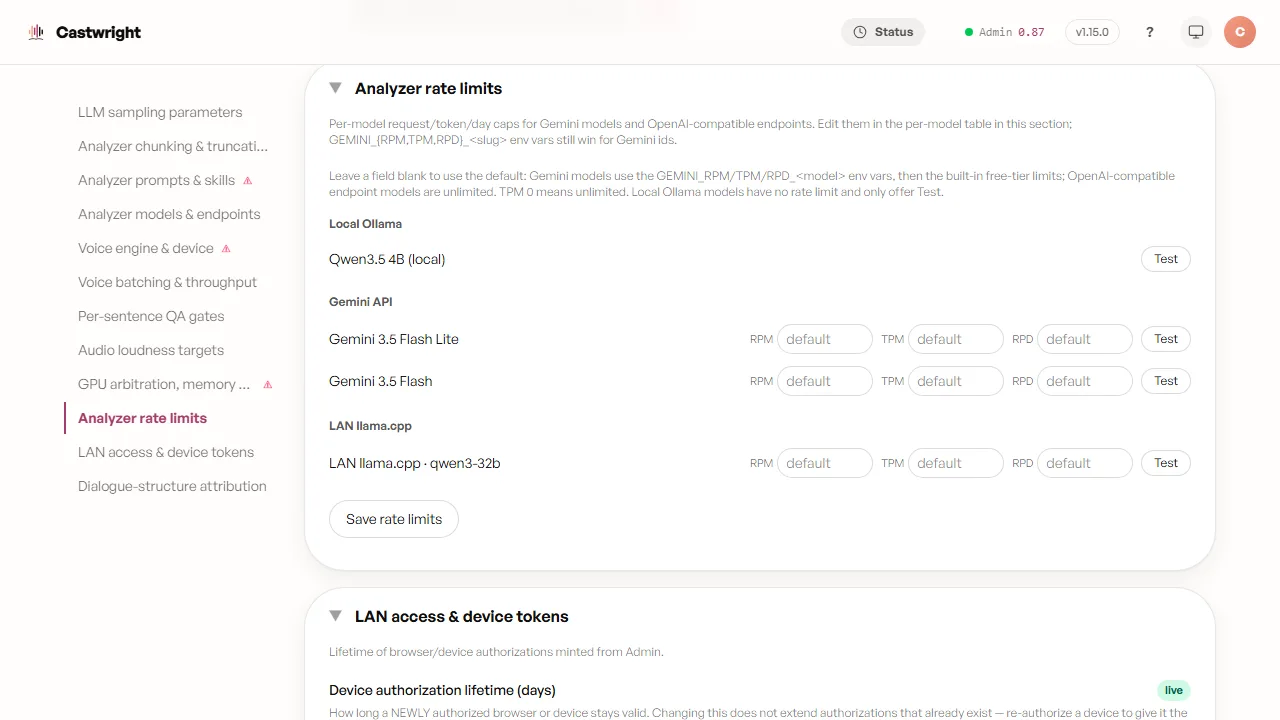
Analysis with any model. Point the analyzer at any OpenAI-compatible server — llama.cpp, llama-swap, LM Studio, vLLM, or OpenRouter — alongside local Ollama and Gemini. Each model gets a Test button that checks it really follows the output format before you spend a book on it (thinking models included), a reasoning-level control, and a block for your own request params. Tell it which GPU the server lives on and it asks before sharing the card your voices are using. More: https://www.castwright.ai/features#any-model
Character identity survives a re-analysis. Re-analysing now only adds to the cast: names, voices and merges stay put, and an uncertain new name gets asked about rather than guessed. "Link to this character" tells Castwright two names are one person. Chapters already hit by the old ID drift need one re-render.
GPU memory looks after itself. Voice designs and Quality previews make the room they need on an 8 GB card, and a speech engine that hits a memory ceiling or a transient GPU error restarts on its own.
Also: My voices now holds designed and cloned voices side by side (design once, cast anywhere; "Don't reuse" gives a character its own); more quote styles across all seven languages (Swiss «…» still partial); and dash-dialogue speaker matching in Russian, French and Spanish is far steadier — on one full Russian novel, affected chapters went from as low as 2% matched to over 92%.
Pinokio: this Update is a big one, once. The first Update to v1.15 does a one-time full voice-engine reinstall and takes noticeably longer; on NVIDIA it pulls about 1.3 GB more (the cuDNN and cuBLAS wheels). A plain restart doesn't trigger it. Pinokio moves to its own Node 24 with this release, but that lands one Update late — if Castwright says its Node is too old, press Update again. If you run Coqui, press Repair on it once (Admin → Model Manager → Installed models). And reload any Castwright tab left open from before the update. Walkthrough: https://www.castwright.ai/blog/updating-to-v1-15-on-pinokio
Where it's still honest: solo project, beta. The clone wizard's record/consent step currently renders with plain browser controls — it works, it just looks rough, and a fix is ticketed. I'd still love testers on an AMD card (supported via ROCm, but I've no AMD hardware to verify it), and anyone cloning a voice in a language other than English.
Hear a sample: https://www.castwright.ai/#demo · Full release notes: https://github.com/dudarenok-maker/Castwright/wiki/Release-Notes-v1.15.0 · castwright.ai · Feedback or a hand: [email protected].