
Preview 36 is out. Foundry has a new experimental rigging wizard with local AI fitting and a set of MCP tools that let an agent inspect the mesh, refine the rig, and show you what it changed.
I wanted a little cartoon to demo it, so I talked to Codex from my phone using speech-to-text. My two main requests were to make a goofy wooden man with rubber-hose cartoon movement and to animate him with a giant acorn. I gave it feedback by voice along the way. Codex made the reference image, generated and refined the mesh in Foundry, fitted and tested the rig through Foundry’s MCP, and took it into Blender to animate and render it. I didn’t place a joint, paint a weight, or set a keyframe by hand.
The Big Lift · Wood Man needs a second try.
What the agent can do in Foundry
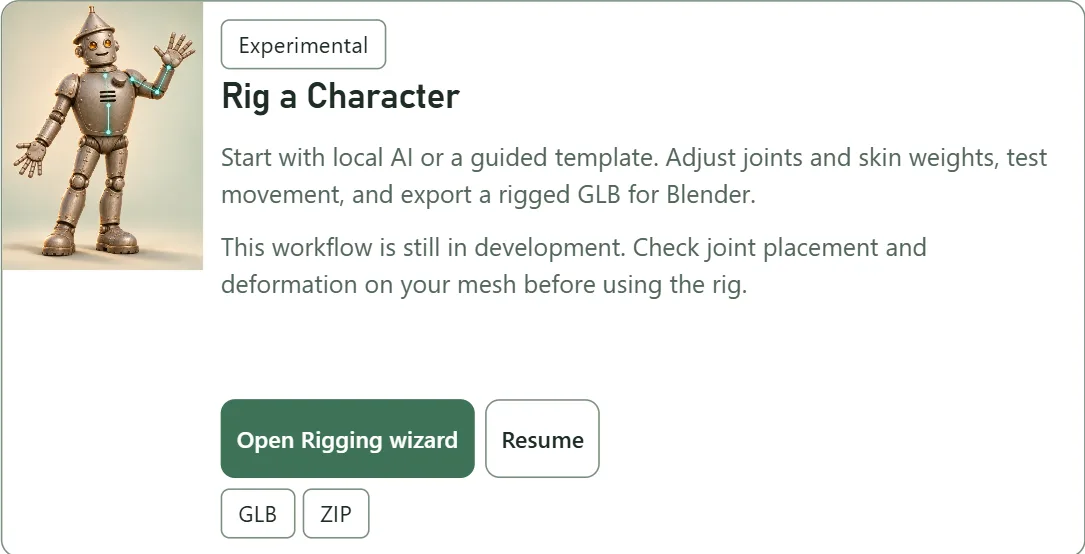
MCP is the connection. The work behind it is giving the agent the same rigging session the wizard uses. Foundry gives each rig and bone a stable identity. A capture carries the source mesh, camera, coordinate frame, and rig revision. An edit targets a specific bone on a specific revision. The agent can preview a change, apply it once, and read the updated rig back from the open wizard.
Preview 36 adds eight rigging calls to the local MCP. They cover capabilities, the current rig, viewport captures, depth probes, basic wizard edits, structured joint commands, previewable batches, and movement checks.
- Start from the asset you’re looking at. Open Rig a Character from Choose a Workflow or History, or use Rig this mesh at the end of a mesh export. Choose the exact saved GLB variant.
- Choose Guided Template or Local AI (TokenRig). The local AI runs on a compatible Windows NVIDIA GPU. Its pinned software and model files download on first use. Fit and binding have presets and Custom controls, and running work can be canceled.
- Keep the whole skeleton. Foundry preserves the predicted bones, branches, orientations, and learned weights. Use the part inspector, axis handles, exact XYZ controls, and bend direction to refine the fit.
- Add or adjust branches. Author fingers, hands, toes, tails, wings, and custom chains. Frame a part, mirror paired joints where appropriate, pin bones you want to preserve, or preview a scoped branch adjustment.
- Give the agent depth measurements. Capture front, side, back, angled, or close-up views. Probe from a pixel into the mesh to see surface hits and depth, check uncertain readings from another angle, and save useful anatomical landmarks.
- Inspect real movement. Bind the rig, bend a joint, and see which parts moved. Inspect weight findings and the heat map, make a targeted brush correction, and rebind. Supported rigs can use learned or conditioned binding, and Blender CPU binding is available.
- Keep control of the live session. Edits are revision-checked and share Undo with the wizard. Retrying the same edit applies it once. You can follow the agent’s camera, take the camera back, or click Stop agent editing. The agent can still inspect a stopped session.
- Take the rig into Blender. The separate ZIP contains a skinned GLB, editable skeleton data, source and binding details, a generated README, and applicable notices. History retains the source mesh and saved rig.
- Connect Codex or Claude Code. The bundled rigging skill explains how to inspect, adjust, test, and export. Claude Code connected to the staged server. Codex produced this demo. The experimental workflow card and wizard are available in all nine Foundry interface languages.
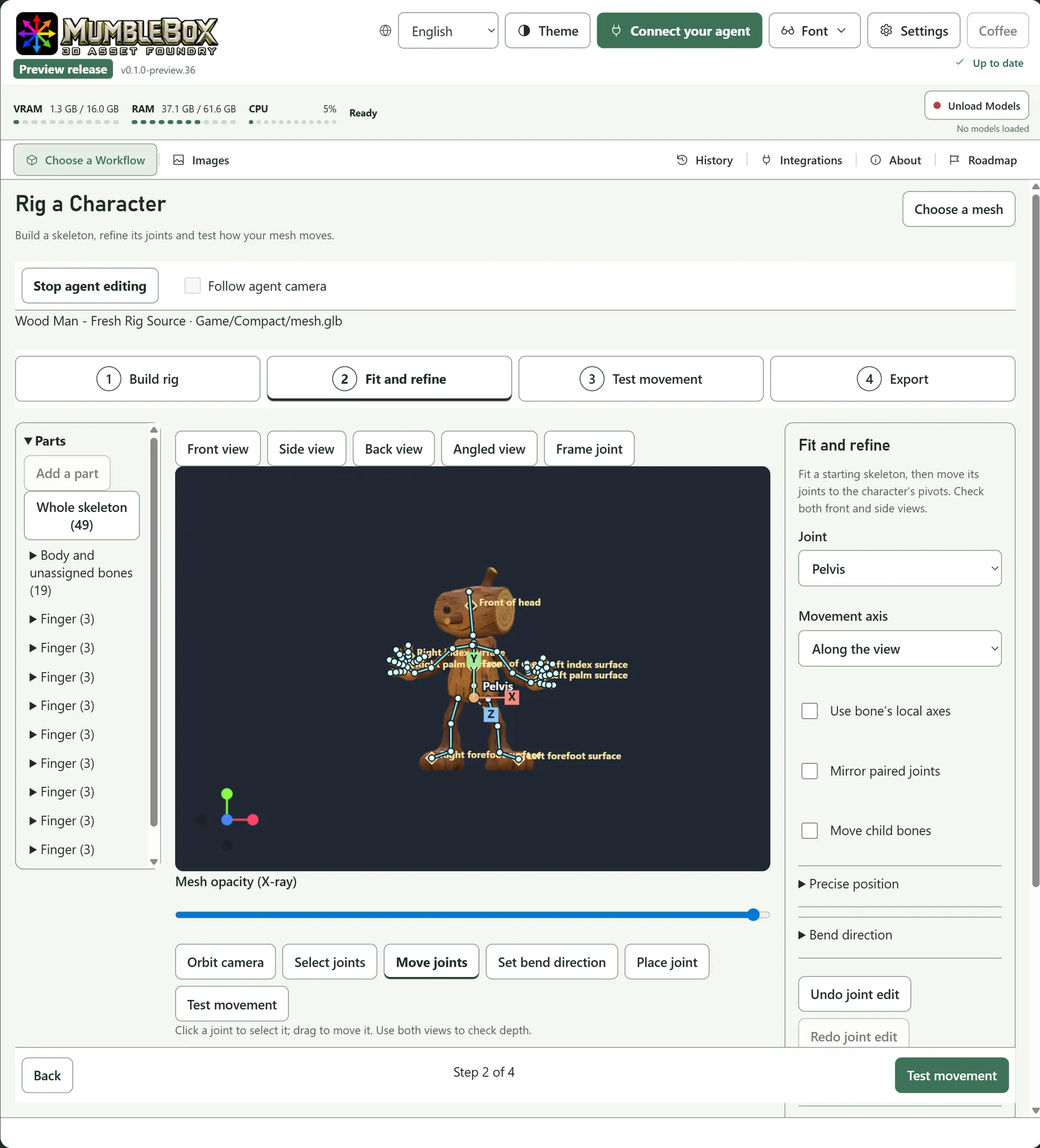
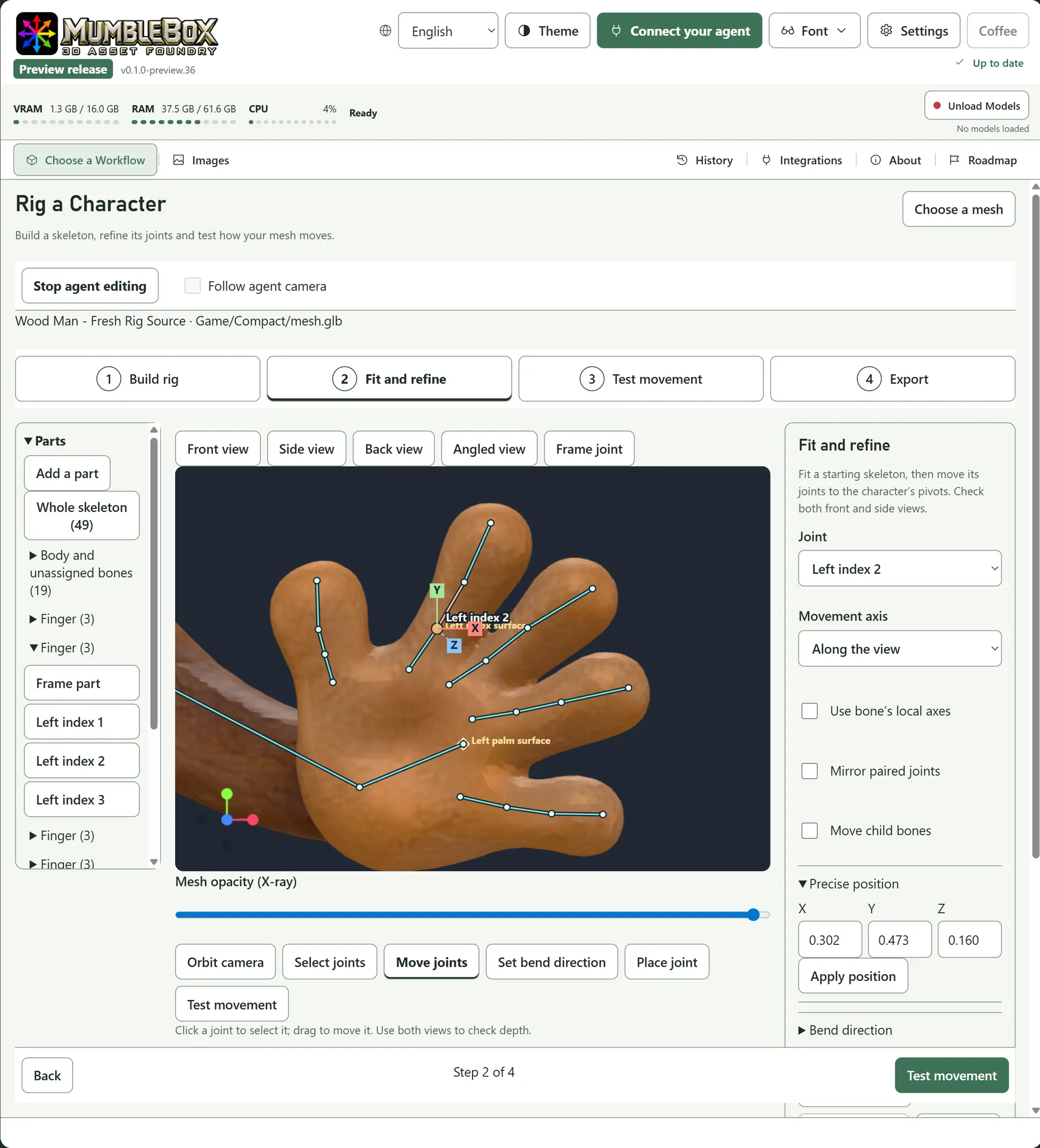
Wood Man’s local AI fit started with 19 body bones. Codex added 30 finger bones, then checked the hands from both sides and corrected places where one finger pulled on another. The 49-bone rig carried its hierarchy and skin weights into Blender.
The acorn was made in Foundry too. Codex rigged its oak leaf in Blender with three joints, so the leaf flexes while the nut, cap, and twig stay rigid.
The Leaf Gag · That’s an unusually vindictive acorn.
Try one joint edit
- Update to Preview 36 in Pinokio and open Foundry. In Connect your agent, follow the setup for your client.
- Make a mesh with Single Image or Text, or open Rig a Character and choose a static GLB from History.
- Start with Guided Template or Local AI (TokenRig). Open Fit and refine and ask your agent to check one elbow from the front and side, show you a proposed adjustment, and test the bend after binding.
- Watch the edit in Foundry. Use Undo or Stop agent editing if you want to take over. Save the rig and open the GLB in Blender when you’re happy with the movement.
This is still in development. If you try it, I’d love to hear which agent and mesh you used, how the connection went, and where you had to step in. Thanks for trying Foundry and sharing what works.
Foundry on Pinokio · Preview 36 on GitHub · MCP and rigging guide



Preview 36 is out. Foundry has a new experimental rigging wizard with local AI fitting and a set of MCP tools that let an agent inspect the mesh, refine the rig, and show you what it changed.
I wanted a little cartoon to demo it, so I talked to Codex from my phone using speech-to-text. My two main requests were to make a goofy wooden man with rubber-hose cartoon movement and to animate him with a giant acorn. I gave it feedback by voice along the way. Codex made the reference image, generated and refined the mesh in Foundry, fitted and tested the rig through Foundry’s MCP, and took it into Blender to animate and render it. I didn’t place a joint, paint a weight, or set a keyframe by hand.
The Big Lift · Wood Man needs a second try.
What the agent can do in Foundry
MCP is the connection. The work behind it is giving the agent the same rigging session the wizard uses. Foundry gives each rig and bone a stable identity. A capture carries the source mesh, camera, coordinate frame, and rig revision. An edit targets a specific bone on a specific revision. The agent can preview a change, apply it once, and read the updated rig back from the open wizard.
Preview 36 adds eight rigging calls to the local MCP. They cover capabilities, the current rig, viewport captures, depth probes, basic wizard edits, structured joint commands, previewable batches, and movement checks.
Wood Man’s local AI fit started with 19 body bones. Codex added 30 finger bones, then checked the hands from both sides and corrected places where one finger pulled on another. The 49-bone rig carried its hierarchy and skin weights into Blender.
The acorn was made in Foundry too. Codex rigged its oak leaf in Blender with three joints, so the leaf flexes while the nut, cap, and twig stay rigid.
The Leaf Gag · That’s an unusually vindictive acorn.
Try one joint edit
This is still in development. If you try it, I’d love to hear which agent and mesh you used, how the connection went, and where you had to step in. Thanks for trying Foundry and sharing what works.
Foundry on Pinokio · Preview 36 on GitHub · MCP and rigging guide